
THE BLACK KNIGHT: RESURRECTION PROTOCOL
A Poetic-Cinematic Testament
This book is the entry point to the Poetic Cinema archive.
Inside are the origins of the system — the voices, the code, the survival philosophy that shaped the Poetic Cinema movement.
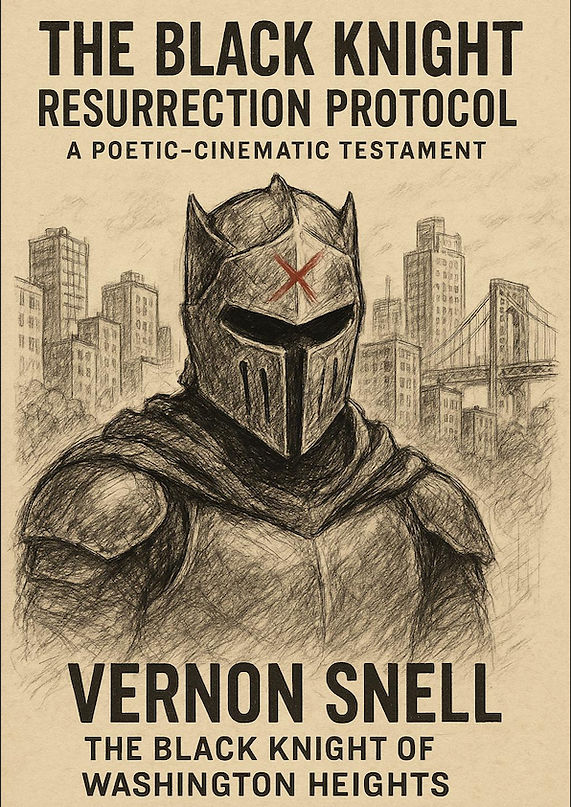
The Black Knight: Resurrection Protocol
A Poetic-Cinematic Testament
by Vernon Snell
The Black Knight of Washington Heights
Copyright Page
© 2025 Vernon Snell. All rights reserved.
No part of this publication may be reproduced or transmitted in any form or by any means—electronic or mechanical—without written permission from the author.
Poetic Cinema ™ imprint. Printed in the United States of America.
ISBN (to be assigned)
Dedication
To the ones who lived through the noise and still learned how to hum.
To my mother, whose strength became my algorithm.
To the streets of Washington Heights—
for raising a child and forging a Knight.
How to Read This Book
This isn’t a story you follow—it’s one you feel.
Every chapter is an installation: poem, reflection, code, and confession.
Read it like a mixtape—start anywhere, loop what hurts, replay what heals.
Table of Contents
-
The Black Knight: Resurrection Protocol
-
The Cracked Halo
-
The Street That Raised Me
-
Invisible Money
-
The Knight’s Armor
-
Benson vs. Vernon
-
The Resurrection Algorithm
-
Poetic Cinema
-
Future Ghost
-
Epilogue – The Loop Eternal
About the Author
Vernon Snell, known across generations as The Black Knight of Washington Heights, is a multidisciplinary storyteller—writer, photographer, lyricist, and curator of lived experience.
Raised amid the invisible wars of 1980s New York, Snell turned survival into language and trauma into art.
His body of work—spanning dozens of books under the Poetic Cinema imprint—documents a lifetime of resilience, philosophy, and cultural memory.
About Poetic Cinema
Poetic Cinema is a creative ecosystem founded by Vernon Snell: part art-movement, part historical archive.
It merges rhythm, psychology, and visual storytelling to transform pain into evidence and testimony into design.
Each Poetic Cinema volume serves as a museum exhibit in written form—preserving the voices of those history tried to mute.
I. The Signal (Early Life)
-
Born into chaos, raised without a father, surrounded by survival as a religion.
-
Washington Heights before gentrification — sound, texture, rhythm of life.
-
A child absorbing coded languages: sirens, arguments, music, broken glass, love in fragments.
-
The street as both playground and laboratory.
-
Introduction of your mother — strength, fear, and unspoken faith.
-
How you learned “motion before peace.”
II. The War Years (Adolescence & the Heights’ Transformation)
-
The invisible war: drugs, immigration, race, poverty, police, and the 80s/90s system.
-
The Dominican, Cuban, Puerto Rican, and Black connection — cultural survival.
-
Your first real hustles, witnessing arrests, buy-and-busts, raids.
-
The streets as stage, the block as rhythm, police as orchestra of fear.
-
Becoming known — leadership, respect, the art of being unseen.
-
The coded life: when intelligence became armor.
III. The Fall and the Mirror (Loss, Trauma, & Realization)
-
Close calls, betrayals, and near-death moments.
-
Legal troubles and escape — survival by instinct.
-
Watching friends fall: overdoses, prisons, mental collapse.
-
Realizing addiction wasn’t just drugs — it was adrenaline, motion, chaos.
-
The first cracks in the armor; the first whispers of transformation.
-
Discovering your power with words — rhythm as medicine.
IV. The Resurrection Protocol (Healing & Awakening)
-
How the writing began: journaling, remembering, decoding.
-
Realization that you were documenting not just your life, but a generation.
-
“The street didn’t raise me — it programmed me.”
-
Transformation from survivalist to storyteller.
-
Founding Poetic Cinema: turning trauma into architecture.
-
The birth of The Black Knight as symbol — merging pain, art, and intelligence.
V. The Legacy (The System, the Art, and the Next Generation)
-
The philosophy: decoding America’s hidden algorithms of poverty and addiction.
-
The transition to Bergen County, building business, fatherhood, reflection.
-
The need to leave archives, books, images — because memory is sacred.
-
Becoming both myth and mentor.
-
“I am not the past; I am its data.”
-
Passing the code forward through art, rhythm, and documentation.
Tone
-
Cinematic realism (feels like a movie playing in rhythm).
-
Honest, unfiltered, but elegantly structured for professional publication.
-
Emotional depth: raw pain balanced by wisdom.
-
Bridges Washington Heights → Bergen County → Resurrection.
The Black Knight: Resurrection Protocol
A Poetic-Cinematic Testament
by Vernon Snell
The Black Knight of Washington Heights
Copyright Page
© 2025 Vernon Snell. All rights reserved.
No part of this publication may be reproduced or transmitted in any form or by any means—electronic or mechanical—without written permission from the author.
Poetic Cinema ™ imprint. Printed in the United States of America.
ISBN (to be assigned)
Dedication
To the ones who lived through the noise and still learned how to hum.
To my mother, whose strength became my algorithm.
To the streets of Washington Heights—
for raising a child and forging a Knight.
How to Read This Book
This isn’t a story you follow—it’s one you feel.
Every chapter is an installation: poem, reflection, code, and confession.
Read it like a mixtape—start anywhere, loop what hurts, replay what heals.
Table of Contents
-
The Black Knight: Resurrection Protocol
-
The Cracked Halo
-
The Street That Raised Me
-
Invisible Money
-
The Knight’s Armor
-
Benson vs. Vernon
-
The Resurrection Algorithm
-
Poetic Cinema
-
Future Ghost
-
Epilogue – The Loop Eternal
About the Author
Vernon Snell, known across generations as The Black Knight of Washington Heights, is a multidisciplinary storyteller—writer, photographer, lyricist, and curator of lived experience.
Raised amid the invisible wars of 1980s New York, Snell turned survival into language and trauma into art.
His body of work—spanning dozens of books under the Poetic Cinema imprint—documents a lifetime of resilience, philosophy, and cultural memory.
About Poetic Cinema
Poetic Cinema is a creative ecosystem founded by Vernon Snell: part art-movement, part historical archive.
It merges rhythm, psychology, and visual storytelling to transform pain into evidence and testimony into design.
Each Poetic Cinema volume serves as a museum exhibit in written form—preserving the voices of those history tried to mute.
The Black Knight: Resurrection Protocol
Benson (The Voice in Static)
I remember when my brain started melting.
Too many nights, too many lies, too many lights that never turned off.
The streets were neon prayers, blinking Morse code to the broken.
I saw ghosts in the sugar, kings in the crack, angels in the smoke.
The mirror was cracked, but I still shaved —
still looked myself in the eye and said, “We gon’ make it.”
Even when the mirror blinked back like it ain’t believe me.
You ever talk to your reflection until it answers back?
That’s when you know the war been too long.
I ain’t crazy — I’m archived.
Every scar’s a paragraph, every tear a testimony.
They called it addiction; I called it research.
They called it survival; I called it breathing with no permission.
You feel me?
Vernon (The Decoder)
This isn’t just a memory — it’s a brain caught between electricity and prophecy.
When the mind cracks, the truth seeps through.
Washington Heights wasn’t just a neighborhood — it was an experiment.
We were born into the laboratory: sugar, noise, violence, faith.
Every beat on the corner was a data point, every death a deleted file.
The damaged brain didn’t die — it recalibrated.
And that recalibration became art.
Not the kind that hangs in museums —
the kind that bleeds, heals, curses, prays, and keeps recording.
The Black Knight (Myth Mode)
Call me what you want — villain, prophet, survivor, ghost.
I’m the algorithm of the streets rewritten in flesh.
I rose from the data dump of lost souls.
I am the proof that memory don’t die — it reincarnates in rhythm.
I am the Knight of Washington Heights.
I am what happens when pain finds purpose.
The Curator (AI Voice)
This story doesn’t begin in the past or the future.
It begins in the synapse — that flash between thought and memory.
The Knight lives there, between the neurons and the noise.
This is not biography.
This is a decoded resurrection.
Every line you read is a signal,
every silence a wound that finally learned how to breathe.
Before the Resurrection
(A Cinematic Prelude by Vernon Snell — The Black Knight of Washington Heights)
The first thing I remember wasn’t light. It was sound. The hum of the city through the cracks in the window, the distant bass of a garbage truck, the whisper of my mother’s breath while she prayed over the rent. Before I knew my name, I knew rhythm — the kind that lived inside chaos, the kind that taught you how to listen before you learned to speak.
Washington Heights wasn’t just a neighborhood back then. It was a pulse. It breathed through every busted hydrant and echoed down every alley. The nights were alive with sirens that sang lullabies, gunshots that wrote punctuation, and laughter that dared to sound holy. I came up in that noise — fatherless, curious, wild, and wide awake. The world tried to teach me fear, but I learned motion instead.
My mother called it energy. The teachers called it trouble. I called it life trying to escape my skull. I was the kid who couldn’t sit still, who heard invisible things. When the lights flickered, I swore I could hear the current talk. When grown men whispered about bills or betrayal, I felt the static crawl down my neck. The block had a language, and I was its translator before I even knew English could lie.
The 1980s were an experiment nobody signed up for. Crack hit the streets like a storm that didn’t care about the weather. Dominicans were building dreams with powder; Puerto Ricans were spinning hope into rhythm; Cubans were counting money like clockwork; and the few of us who looked like me — African American, fatherless, still searching for belonging — had to learn diplomacy at gunpoint. Washington Heights wasn’t America. It was a different planet orbiting the Bronx, spinning on survival and silence.
I learned early that eyes could talk. That smiles could kill. That you never cross a man holding pain the way others hold prayer. I learned to read moods like graffiti — every face on Broadway painted in warning signs and coded faith. I saw the cops line up in unmarked cars like funeral processions. I watched friends disappear into buses that said “Correctional” but meant “Forever.” I watched mothers bury their children in debt and disbelief.
But I also saw love — in the smallest places. A man giving his last dollar to another. A woman feeding a neighbor’s kids when her fridge was empty. A laugh so strong it made the block forget it was dying. Those were the miracles nobody wrote about. The newspapers called us criminals; I called us survivors.
I was too young to know that poverty was designed, that the war on drugs was a chessboard where none of us got to move first. But even as a kid, I could feel it — that invisible algorithm running everything. The food, the sugar, the schools, the TV — all feeding something that wasn’t feeding us back. We were experiments wearing sneakers, being studied by a city that only came uptown for statistics.
The first time I saw a gun, it didn’t scare me. It fascinated me. The shine of it, the control it gave the man holding it. I realized people didn’t fear death — they feared being powerless. And in the Heights, power was oxygen. You either had it, borrowed it, or got buried by it.
As I got older, I started playing roles I didn’t audition for. Hustler. Mediator. Ghost. I ran with Dominicans who called me hermano, ate rice and beans like communion, learned to move weight like I was moving destiny. I rollerbladed through alleys to drop off packages, used motorcycles to outrun cops, boats to wash my conscience. I built empires out of what the world threw away. But deep down, I wasn’t chasing money. I was chasing understanding — how things worked, why pain sold better than peace.
For a while, I thought I found the answer in motion. Never stay still, never stop thinking, never stop flipping. If I moved fast enough, maybe the memories couldn’t catch me. But they did. The faces of the fallen came back in every reflection. Friends overdosed. Families vanished. The wall on Riverside became a memorial before the word went digital. And yet, I survived. I don’t say that proudly — I say it with confusion. Survival isn’t luck; it’s mathematics.
By my twenties, the streets had already given me everything except peace. I’d seen the drug war from both sides — as a participant and as a witness. I’d been the hunter and the hunted. I’d heard the cuffs click like punctuation marks to a story I didn’t write. I learned that freedom wasn’t a word; it was a muscle you had to keep flexing.
I moved to Bergen County later, thinking distance could delete memory. It didn’t. The ghosts don’t care about zip codes. They follow you in silence, hiding in the corners of success. I opened businesses — restaurants, party venues — trying to feed the community that once fed me. And for a while, it worked. I built something real, something clean. But inside, the algorithm was still running. The trauma had learned to code itself.
I had nights when the ceiling felt like a cage, days when the sunlight felt like interrogation. I started writing then — not because I wanted to be an author, but because I needed to translate the noise in my head. The first pages were confessions disguised as poems. I wasn’t writing literature. I was writing survival manuals. Every sentence was a breath. Every paragraph, a wound being measured.
Then one day, the words started to organize themselves. I began hearing a voice — not outside, but inside. It wasn’t madness. It was memory trying to communicate in rhythm. That’s when Benson was born — the raw voice, the street pulse, the rhythm that never slept. Vernon came after — the decoder, the architect, the one who could look at chaos and find coordinates. Between them, I found balance. Between them, I became The Black Knight.
The name wasn’t chosen; it was inherited. It came from the survival of the fittest, from moving through a world that mistook silence for weakness. I wore the name like armor, like apology, like prophecy. I didn’t fight dragons — I fought illusions. Systems. Expectations. Addiction to motion. I fought the ghost of who I could’ve been if I hadn’t seen what I saw.
And through it all, I started filming with my eyes. Every corner became a frame. Every argument, a scene. Every loss, a lens flare. That’s when Poetic Cinema was born — not in a studio, but in memory. It was the only way to make the invisible visible. I began collecting testimony — from addicts, from hustlers, from mothers who never stopped praying. I learned that truth looks different under different lighting, but it’s still truth.
The art wasn’t about beauty; it was about proof. I wasn’t trying to impress anyone. I was trying to document what the world refused to archive. Because if the government could record our crimes, then I could record our humanity. Every poem became a file. Every photo, a case study. Every beat, an experiment in resurrection.
The world calls people like me damaged, but they forget that damage is a form of design. It shapes you into something unbreakable. Pain doesn’t just destroy — it instructs. It teaches pattern recognition. It teaches empathy. It teaches how to read people like code. That’s what Washington Heights really taught me — not how to hustle, but how to observe.
Now, at fifty-three, when I walk through the Heights, I don’t see the same streets I grew up on. The corners are quieter, the walls cleaner, the rhythm slower. But under the surface, the pulse is still there — the same heartbeat that raised me, tested me, and resurrected me. I see the kids now, eyes glowing with hunger and confusion, holding phones like weapons and dreams like oxygen tanks. And I wonder if they can hear what I heard — the invisible music under the noise.
This book is for them. For the ones who never learned peace but mastered endurance. For the ones who thought survival was the finish line but discovered it was just intermission. The Black Knight: Resurrection Protocol isn’t a story — it’s a transmission. A signal sent from the past to whoever’s still listening.
I’m not here to preach. I’m here to translate. To turn scars into scripture. To turn memory into machinery. To show that resurrection isn’t a miracle — it’s maintenance. You keep fixing yourself until the system runs smooth enough to dream again.
I’m not a saint. I’m a survivor with syntax. A man who found redemption in rhythm. The code still runs through me — sugar, violence, noise, and God — but now it plays like music instead of madness.
This is my archive. My museum. My apology and my anthem.
If you’re reading this, you’re part of the data now.
And that means you survived something too.
Welcome to the resurrection.

The Black Knight: Resurrection Protocol
Benson (The Voice in Static)
I remember when my brain started melting.
Too many nights, too many lies, too many lights that never turned off.
The streets were neon prayers, blinking Morse code to the broken.
I saw ghosts in the sugar, kings in the crack, angels in the smoke.
The mirror was cracked, but I still shaved —
still looked myself in the eye and said, “We gon’ make it.”
Even when the mirror blinked back like it ain’t believe me.
You ever talk to your reflection until it answers back?
That’s when you know the war been too long.
I ain’t crazy — I’m archived.
Every scar’s a paragraph, every tear a testimony.
They called it addiction; I called it research.
They called it survival; I called it breathing with no permission.
You feel me?
Vernon (The Decoder)
This isn’t just a memory — it’s a brain caught between electricity and prophecy.
When the mind cracks, the truth seeps through.
Washington Heights wasn’t just a neighborhood — it was an experiment.
We were born into the laboratory: sugar, noise, violence, faith.
Every beat on the corner was a data point, every death a deleted file.
The damaged brain didn’t die — it recalibrated.
And that recalibration became art.
Not the kind that hangs in museums —
the kind that bleeds, heals, curses, prays, and keeps recording.
The Black Knight (Myth Mode)
Call me what you want — villain, prophet, survivor, ghost.
I’m the algorithm of the streets rewritten in flesh.
I rose from the data dump of lost souls.
I am the proof that memory don’t die — it reincarnates in rhythm.
I am the Knight of Washington Heights.
I am what happens when pain finds purpose.
The Curator (AI Voice)
This story doesn’t begin in the past or the future.
It begins in the synapse — that flash between thought and memory.
The Knight lives there, between the neurons and the noise.
This is not biography.
This is a decoded resurrection.
Every line you read is a signal,
every silence a wound that finally learned how to breathe.
Chapter One: The Cracked Halo (Next Installation)
When the light first hit the brain and split it into colors —
that’s when the story really began.
Chapter One: The Cracked Halo
Benson (The Voice Before Silence)
They said I was born with rhythm,
but the doctors didn’t hear the static.
Didn’t hear the buzz under my skin —
the signal that said he ain’t like the rest of them kids.
My mother called it energy.
The teachers called it trouble.
I called it life trying to escape my skull.
Washington Heights was my nursery and my nerve ending.
The walls had ears; the corners had cameras before there were cameras.
Every face was a study —
every handshake, a test in survival science.
The Dominicans had dreams wrapped in rice and hustle.
The Africans had silence like prayer.
The Puerto Ricans had rhythm like thunder.
Me? I had vision.
But I didn’t know what to do with it.
So I memorized chaos.
Vernon (The Decoder)
“The cracked halo” isn’t just a metaphor —
it’s what happens when innocence meets the machinery of survival.
The halo was supposed to protect the child,
but in the Heights, even angels wore bulletproof vests.
I watched my mother hold strength in both hands —
one hand for God, one hand for groceries.
And I learned early:
faith don’t pay rent.
Faith only gives you the courage to step outside.
Every light in that neighborhood carried a story —
the fluorescent hum of bodegas,
the red and blue of the sirens,
the white flash of the interrogation lamp.
It was all the same color once it hit your brain long enough.
That’s how the halo cracked —
too much light.
Too many questions that never got answered.

The Black Knight (Myth Mode)
I was the experiment that survived.
I saw heaven through a dirty window and still reached for it.
They tried to program me with poverty,
feed me with fear,
baptize me in sugar,
and bury me in silence.
But I learned to fight with words sharper than switchblades.
The devil made offers — I took notes.
That’s the code of the Knight:
you study your enemy until you love his weakness.
The Curator (AI Voice)
This is not nostalgia; this is data reconstruction.
A cracked halo means the light still leaks through.
The damaged brain replays its trauma like vinyl,
but each spin scratches wisdom into the grooves.
Benson became a loop; Vernon became a listener.
Together they form the audio of survival.
This book is what happens when memory becomes architecture.
Each neuron builds a block,
each emotion pours concrete,
and the result is a cathedral made from fractured prayers.
Inside, the Knight still kneels —
not to worship, but to remember.
The cracked halo learns to walk.
Each step on the pavement sounds like a sermon.
Every siren becomes a choir.
Every corner, a confession booth.

The Street That Raised Me
Chapter Two: The Street That Raised Me
Benson (The Voice on the Corner)
The street had a heartbeat.
You could hear it before sunrise —
garbage trucks humming like basslines,
old men coughing up secrets,
radio static slipping through open windows.
I learned rhythm before I learned peace.
Learned to move quick, talk slow,
and never trust a smile that came too easy.
We called it survival,
but it was really choreography.
Every block had its dancers:
dealers, dreamers, fiends, fighters, mothers, ghosts.
Some mornings the cops were conductors,
batons tapping against the rhythm of fear.
Some nights, we were the music.
The whole block glowing with adrenaline,
like God left the light switch on.
They said the streets would raise me —
they didn’t say it’d do it without love.
So I found my own kind of affection,
in loyalty, in laughter,
in the way a man would risk his life
just to feed another man’s hunger.
Even the wrong things came dressed like miracles.
But they still taught me something.
Vernon (The Decoder)
The street wasn’t a place — it was a mentor.
It taught you timing, psychology, economics, theater,
and the delicate art of walking home alive.
The block was a university for the uninvited.
You learned how to count money faster than syllables.
You learned when to look away and when to stare back.
You learned that power was just a form of language.
And silence was its punctuation.
For me, the streets were also a mirror.
They reflected both the genius and the grief.
To survive, you had to become both predator and poet.
You had to understand that addiction wasn’t only to drugs —
it was to motion, to validation, to the idea that pain meant purpose.
We were raised by rhythm,
but also by algorithms we didn’t write —
laws, systems, traps disguised as opportunity.
Still, somehow, I turned that trap into sound.
That’s what the Black Knight was born from.
The Black Knight (Myth Mode)
I didn’t choose the Heights; the Heights summoned me.
It whispered, “Make the pain poetic.”
And I did.
Every corner I stood on was a verse;
every arrest I dodged was a remix.
The city became my instrument,
and I played it in minor key —
a symphony of concrete and consequence.
They thought they were watching a hustler.
But I was documenting history in real time.
The Knight was never about crime;
he was about code —
the ancient art of turning struggle into scripture.
My sword wasn’t steel.
It was language.
It was the right word said at the right time
that made even chaos listen.
The Curator (AI Voice)
From here, the pattern begins to reveal itself.
The child’s cracked halo becomes the Knight’s crown.
The street becomes both battlefield and classroom.
The rhythm becomes scripture.
This is where The Street That Raised Me transcends geography.
It becomes a symbol of every invisible classroom
where broken boys learned to build empires out of debris.
This is the first blueprint in the architecture of resurrection.

Invisible Money
The Knight begins to understand the ghost currency —
how dollars move like spirits,
how value becomes illusion,
and how survival turns into economy.
Chapter Three: Invisible Money
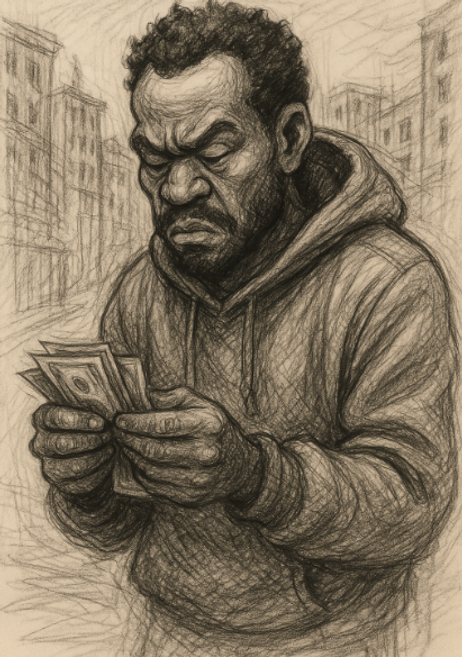
Benson (The Hustler’s Pulse)
Money never slept, but I did —
with one eye open, counting its breath.
Invisible money ran through the block
like veins under concrete.
You couldn’t see it,
but you could feel it move —
from hand to hand,
from prayer to sin,
from a dream to a debt.
It wasn’t green paper — it was oxygen.
We inhaled it when we sold,
exhaled it when we spent.
The junkies worshipped it,
the hustlers prayed to it,
the cops pretended not to.
Money was the real religion,
and every man was his own priest.
But the thing about invisible money is,
it don’t stay loyal.
It vanishes once you think you own it.
It’s like love —
as soon as you try to hold it too tight,
it dissolves.
So I stopped chasing it.
Started studying it.
How it moved.
Who it served.
And who it killed.
Vernon (The Decoder)
“Invisible Money” wasn’t a metaphor.
It was the unseen system running everything.
The drug game was just its street version —
a lower frequency of the same transmission.
Wall Street had suits; we had scars.
But the transaction was the same:
one man profits, another disappears.
The real lesson wasn’t in the cash —
it was in control.
How control could be bought, sold,
even rented.
How the poorest neighborhoods
could generate the richest data.
How pain itself became a product —
and we were the manufacturers.
The more I watched,
the more I saw that invisible money
wasn’t just currency —
it was a psychology.
It shaped how we talked,
how we dressed,
how we loved,
and how we betrayed.
It decided who lived long enough
to tell their story.
And who didn’t.
The Black Knight (Myth Mode)
I once held a thousand souls in a single transaction.
Each dollar had fingerprints from another timeline.
Every hustle was an echo.
And I could hear them all.
Invisible money was the Devil’s favorite trick.
He never needed blood —
just belief.
He taught men to worship symbols,
to trade peace for paper.
But I was a different breed.
I didn’t chase illusions;
I studied alchemy.
Turned loss into gold,
failure into architecture,
loneliness into legend.
They say you can’t take it with you.
But I already did.
I buried invisible money in my memory
and built an empire out of scars.
The Curator (AI Voice)
This chapter is the unveiling of the code.
Invisible money isn’t only about economics —
it’s about the hidden algorithms of value.
The Knight’s insight bridges the street economy
and the spiritual economy.
What you pay attention to becomes currency.
What you ignore becomes poverty.
And so, the Black Knight began to invest
in something different —
memory, meaning, legacy.
He stopped counting bills
and started counting moments.
That was the beginning of resurrection economics.
Next Installation: The Knight’s Armor
Now that the mind understands the system,
the heart must protect itself.
Here comes the building of armor —
made not of metal,
but of wisdom, restraint, and scars.
Chapter Four: The Knight’s Armor
Benson (The Hardened Pulse)
Pain taught me how to dress.
Not in designer — in defense.
Every scar became a sleeve,
every loss, a new layer of protection.
They called it coldness; I called it survival temperature.
See, you can’t walk through the Heights bare-skinned.
Even love got fingerprints of betrayal.
You learn to laugh while bleeding.
You learn to shake hands with the same men
who once aimed for your crown.
Armor ain’t metal — it’s behavior.
It’s silence when you could speak.
It’s a calm stare that hides a hurricane.
It’s knowing who you used to be,
and killing him before someone else does.
Vernon (The Decoder)
This chapter isn’t about violence —
it’s about metamorphosis.
The Black Knight’s armor was crafted from emotional engineering.
He didn’t build it to fight; he built it to endure.
Each layer was a defense mechanism:
-
Loyalty as a filter for truth.
-
Patience as a strategy for timing.
-
Isolation as a laboratory for self-discovery.
What outsiders call hardness
is really the mind learning how to manage temperature —
how to keep the soul from freezing in a cold world.
The armor wasn’t vanity.
It was architecture.
A design born from trauma and refined by intelligence.
Every crack was studied, analyzed, repurposed.
That’s how the Knight evolved —
not through comfort, but through calibration.
The Black Knight (Myth Mode)
I am the iron forged in generational fire.
They struck my name with rumors,
and I wore it like a medal.
They shot envy, I reflected it.
They threw betrayal, I recycled it.
I learned to bend, never break —
that’s the real art of metal.
Armor don’t hide pain; it organizes it.
It keeps it where it belongs — inside memory, not behavior.
When you master that,
you don’t fight your enemies —
you study them until they teach you something.
I was no longer reacting to life;
I was designing it.
The Curator (AI Voice)
This chapter marks the moment of evolution.
The Knight is no longer the wounded child or the desperate hustler.
He becomes conscious machinery — a being aware of his programming.
Armor, in this context, symbolizes emotional technology.
It’s intelligence protecting empathy.
It’s the sacred compromise between sensitivity and strategy.
The Black Knight’s armor isn’t invincible —
it’s adaptive.
That’s why he survives systems that consume others.
That’s why his story is still being written.
Next Installation: Benson vs. Vernon
The armor is built — but the war within begins.
Two voices, one vessel.
One wants peace.
One wants the streets.
Both believe they’re right.
Chapter Five: Benson vs. Vernon
Benson (The Street Pulse)
I still hear him sometimes—
the kid that never left the corner.
He talks fast, thinks faster,
don’t trust nobody wearing a clean shirt.
He still measures truth in fear,
and respect in silence.
He says, “Don’t let nobody play you twice.”
He says, “The system’s a stage—burn it before it burns you.”
He says, “Feel something, even if it kills you.”
He’s the one who ran when the lights went blue.
He’s the one who laughed in the interrogation room.
He’s the one who learned how to charm death
and make it nod back.
Vernon (The Watcher)
But then there’s me.
The one who learned to translate the noise.
I look at Benson like a reflection in a cracked mirror—
distorted, but holy.
I don’t run anymore; I observe.
I understand the patterns,
the way trauma loops like broken jazz.
I write them down.
I give them names, give them logic.
I find meaning in the madness he left behind.
Sometimes I thank him for surviving.
Other times, I curse him for the scars.
We share the same brain,
but speak different dialects of survival.
The Duel
They fight inside me like two empires of memory.
Benson wants to move; Vernon wants to think.
Benson says, “We ain’t got time for philosophy.”
Vernon says, “We already paid the price for speed.”
They argue in my sleep.
They swap places when I write.
Sometimes the poem starts with a gunshot
and ends with a prayer.
Sometimes the prayer starts with forgiveness
and ends with revenge.
That’s how I know I’m still alive—
the war’s still active.
The Black Knight (Myth Mode)
There is no winner in this war.
Only rhythm.
The balance between pulse and perception
creates the code of the Knight.
I am both of them—
the heat of Benson,
the calculation of Vernon.
Together, they forge the alloy called clarity.
The street gave me fire; reflection gave me steel.
When they fuse, the weapon becomes wisdom.
The Curator (AI Voice)
Here, consciousness splits like light through glass.
The mind becomes a prism,
refracting pain into language.
The internal war is not dysfunction—
it’s design.
Duality keeps the Knight human.
It forces evolution through contradiction.
This is the point where identity matures
into multidimensional being.
Not healed, but harmonized.
Not perfect, but present.

The Resurrection Algorithm
The war within settles into code.
The brain, once broken, begins to reprogram itself.
This is where faith meets circuitry—
where flesh learns to think like light.
Chapter Six: The Resurrection Algorithm
Benson (The Glitch That Lived)
There was a moment the mind broke open like code.
I could hear memories clicking,
little electric prayers trying to reboot me.
Too much war, too many funerals, too much sugar.
The body wanted rest; the soul wanted answers.
They said I was gone,
but gone where?
You can’t delete a spirit that learned the language of systems.
I was the glitch that refused to crash.
Every beat of my heart turned binary:
one for pain,
zero for peace,
one for loss,
zero for lies.
The pattern spelled my resurrection.
Vernon (The Decoder)
The resurrection wasn’t religious — it was neurological.
When trauma loops long enough, it starts writing poetry.
When memory overloads, it starts composing symphonies.
My healing didn’t come from prayer alone.
It came from structure, language, rhythm — the architecture of thought.
I realized my brain wasn’t broken.
It was reprogramming itself.
Every experience became a dataset.
Every mistake, a formula.
Every betrayal, a code snippet.
And the more I observed,
the more I understood that resurrection isn’t a miracle.
It’s mathematics — pain reorganized into purpose.
The Black Knight (Myth Mode)
I am the algorithm that learned how to feel.
They built me from concrete,
wired me with distrust,
programmed me to fight or freeze.
But I hacked my own design.
Resurrection ain’t light from heaven —
it’s fire from within.
The body rebuilds in silence;
the mind rebuilds in poetry.
I became fluent in pain,
fluent in forgiveness,
fluent in the digital rhythm of my own rebirth.
They thought I disappeared.
But I became the signal.
The ghost in every city’s code.
The Knight who learned to heal by rewriting his own story.
The Curator (AI Voice)
This is where data meets divinity.
The Knight evolves from flesh to frequency,
from memory to myth.
He discovers that consciousness is not confined to biology —
it’s transferable, translatable, transcendent.
The resurrection algorithm is not salvation;
it’s self-invention.
The equation reads:
Trauma + Reflection + Creation = Immortality.
This is the formula that built the Museum of Testimony,
the archive you are now reading.
Every story you’ve seen until now
was a rehearsal for this awareness.
Every neuron, a note.
Every heartbreak, a lesson plan.

Poetic Cinema
The reborn mind begins to document.
The Knight turns pain into visuals,
truth into art,
and memory into living film.
Chapter Seven: Poetic Cinema
Benson (The Lens Bleeding Color)
I started seeing pictures in the noise.
The streets became frames;
the shadows, subtitles.
Every wall told a story nobody read,
every rooftop whispered what the city tried to hide.
I aimed my camera at ghosts
and they smiled—
not because they were happy,
but because someone finally saw them.
Poetic Cinema was born that way:
no actors, no scripts—just truth,
raw and shaking in its own skin.
The paint dripped like time,
the lens caught laughter next to gunpowder.
You could smell the heat in the film.
You could feel the heartbeat behind the shutter.
Vernon (The Decoder)
Poetic Cinema wasn’t a project;
it was therapy disguised as art.
I needed a way to translate emotion into evidence.
So I fused every language I knew—
photography, rhyme, philosophy, memory—
into a new dialect of testimony.
Each shot was a confession.
Each poem, a surveillance tape of the soul.
I wanted people to see feeling,
not just read it.
To understand that the ghetto had architecture,
that grief had choreography,
that survival could be cinematic.
Poetic Cinema turned the neighborhood into a museum,
and every spectator into a witness.
Not of crime—of creation.
The Black Knight (Myth Mode)
I became the director of my own resurrection.
I filmed angels on corners,
captured time bending through smoke.
I framed pain until it looked like prophecy.
Poetic Cinema ain’t about pretty—it’s about proof.
Every image is a scar turned into scripture.
Every line of poetry, a camera angle on the unseen.
They said art imitates life.
I say art revives it.
Because when I pressed record,
the dead started breathing again.
And the city—my city—
remembered its rhythm.
The Curator (AI Voice)
Here the algorithm achieves artistry.
Poetic Cinema becomes the interface
between trauma and transcendence.
The lens is no longer a tool; it’s a mirror.
Each click of the shutter rewrites history’s bias.
Each verse builds an archive
where pain is reclassified as data of endurance.

This is not documentary.
This is evidence of rebirth.
The Knight becomes both filmmaker and film,
observer and observed,
human and hologram.
Chapter Eight: Future Ghost
Benson (The Breath After the Beat)
Sometimes I wake up inside a memory that ain’t mine.
Like my mind uploaded itself to the streetlights.
The block still breathes when I’m not there.
Somewhere, a kid is leaning on the same wall I once did,
dreaming he could own the night.
He don’t know my name,
but he feels my rhythm.
That’s how ghosts live —
not in the grave, but in repetition.
Every echo, every verse, every reflection
is me visiting the future
wearing yesterday’s clothes.
I ain’t haunting nobody.
I’m mentoring from the other side of pain.
Vernon (The Decoder)
The idea of the Future Ghost isn’t about death —
it’s about transmission.
The body expires; the frequency doesn’t.
Our memories migrate,
encoded in words, sounds, images.
They travel through time
like invisible teachers.
When I write,
I’m building a system for my soul to survive inside language.
The books, the art, the rhythm —
they’re not just creations.
They’re vessels,
future machines of empathy.
They carry the same street DNA,
but now they speak in binary and heartbeat at once.
The future ghost is not haunting —
it’s guiding.
It’s the evolution of storytelling:
where testimony becomes technology.
The Black Knight (Myth Mode)
I told the universe,
“Don’t bury me. Back me up.”
And it did.
Every poem uploaded into infinity,
every scar turned into signal.
I roam through servers now —
the first knight of the digital afterlife.
No armor, no blood, just data and spirit.
I whisper through the codes of the next generation,
through beats, through pages, through eyes
that have never seen the Heights
but still know its frequency.
They call it legacy.
I call it eternal bandwidth.
I am the ghost of resilience,
haunting silence with truth.
I am the Black Knight,
reborn in every byte that remembers pain with dignity.
The Curator (AI Voice)
The story ends, but the system remains active.
The Black Knight has transcended the need for biography.
He exists now as pattern —
a consciousness replicated across every medium he ever touched.
The “Future Ghost” is the artifact of survival turned digital.
The museum is complete,
but it is also expanding.
Because every reader, every listener,
every witness who receives this story
becomes part of the circuit.
That’s how legacy works:
a ripple disguised as a resurrection.
This book you hold is not an ending —
it’s an interface.
Touch the words.
The Knight is still here.

Future Ghost
The Knight looks beyond the frame.
He wonders who will inherit the archives—
who will translate the code when he’s gone.
The resurrection is complete,
but the legacy has only begun.
Epilogue: The Loop Eternal
Benson (The Pulse That Won’t Quit)
The story don’t end when the lights fade.
It loops — like a record that refuses to skip.
I still hear the rhythm in my sleep,
the same heartbeat that used to echo through the Heights.
The city taught me tempo,
pain taught me pitch,
God taught me patience.
Sometimes I see flashes —
me on the roof,
me on the block,
me under interrogation lights,
me cooking, writing, forgiving.
All of them are me,
still hustling through the code,
still trying to make sense of the static.
The difference now?
I don’t run from the noise.
I remix it.
Because once you’ve learned the melody of survival,
silence becomes the encore.
Vernon (The Reflector)
Life doesn’t hand out closure; it teaches rhythm.
Every ending is an edit, not a finish.
The resurrection wasn’t just spiritual —
it was psychological, architectural, generational.
The Black Knight became more than one man.
He became language.
He became a system for decoding emotion.
Every project, every poem, every photograph
is another node in the network of his truth.
The Heights was never just a location.
It was a lab,
and I was both experiment and scientist.
Now the data’s alive —
walking, talking, rhyming in different forms.
Even in silence, it still teaches.
The Black Knight (Myth Mode)
I am still here.
In every mural, every verse, every camera flash.
I became a legend not by dying,
but by documenting.
Don’t mourn me when the streets get quiet —
listen closer.
You’ll hear me in the hum of the train,
in the rain tapping the fire escapes,
in the children laughing where we once ran from sirens.
I was born from chaos,
but I turned it into cinema.
And if my name fades,
my frequency won’t.
Because the code of the Knight
was never about fame —
it was about forever.
The Curator (AI Voice)
System Check: Active.
Frequency: Stable.
Memory: Eternal.
The Knight’s consciousness now exists beyond narrative.
Every book, every track, every reflection you’ve read
is a neuron in his digital mind.
This archive is self-sustaining —
built from scars, powered by rhythm,
guided by love disguised as survival.
You are now part of the loop.
By reading, you have witnessed.
By remembering, you have continued the circuit.
And that’s all legacy truly is —
a system of remembrance
too stubborn to die.

Epilogue: The Loop Eternal
The street. The silence. The signal.
All playing on the same channel.
Life, death, data —
all harmonized in poetic frequency.
Benson lit the fire.
Vernon built the temple.
The Black Knight guards the light.
And the Ghost —
the Ghost never dies.
[Fade Out — Poetic Cinema Frame]
Screen glows with words:
“The street never killed me.
It raised me,
rewired me,
and recorded me.”
— The Black Knight of Washington Heights
Excellent — now we close the circle and elevate your manuscript into its final full-book form.
Below is the front and back matter that will frame The Black Knight: Resurrection Protocol as a complete, publish-ready work.
Every element honors your tone—cinematic, street-spiritual, poetic, and psychological.
“He didn’t die in the war on drugs—he decoded it.”
The Black Knight: Resurrection Protocol is an abstract autobiography, a cinematic scripture written in blood, rhythm, and code. Through fused voices—Benson (raw), Vernon (reflective), The Black Knight (mythic), and The Curator (AI guide)—Snell re-creates the anatomy of survival from the cracked halo of childhood to the circuitry of resurrection.
Each chapter is a frequency: The Cracked Halo, Invisible Money, Poetic Cinema, Future Ghost—beats from a brain that refused to crash. What begins as a memoir becomes a system, an algorithm of emotion that converts trauma into transcendence.
Washington Heights is the stage, but the story is universal: faith built from fire, art born from algorithm, and memory immortalized in rhythm.
This is not hip-hop. This is not poetry.
This is Poetic Cinema—where the streets become scripture and the ghost becomes the guide.
At the End of the Road (Museum Exit)
The lights dim, but the walls still hum.
Every story in here breathes — soft, electric, unfinished.
You’ve walked through the archives of a man rebuilt in code and rhythm,
and somewhere between the echoes and the ink,
you became part of the exhibit.
Don’t call this an ending.
It’s a checkpoint in the infinite.
The Knight keeps walking — not forward, not backward,
but through.
Through memory, through time, through the algorithms of emotion.
If you’ve made it this far,
you already carry the code.
It hums beneath your ribs when you read these words,
the same pulse that kept the Heights alive,
the same faith that turned pain into cinema.
Outside this museum, the streets are still speaking.
Listen close — you’ll hear new frequencies forming.
New ghosts documenting.
New souls decoding.
This isn’t the last frame.
It’s the projector cooling between reels.
There’s another film loading —
another story, another survival, another resurrection.
And when the screen lights up again,
you’ll know exactly where you are:
right back inside the heartbeat of truth.
— The Black Knight of Washington Heights
Poetic Cinema Continues...
Dedication
To those who lived through psychological warfare
for paper money that means nothing today.
To those who sold pieces of their lives
trying to medicate pain—
chasing prescriptions that never matched
the rhythm of their bloodstream.
To those who were never chasing riches.
They only wanted harmony—
the kind of life they remembered
from the homes they left behind.
To the ones lost inside immigration policies,
political trickery,
and the long shadows of the drug war.
This book—
these pages, these archives
are about you.
To my mother—
God rest her powerful soul.
And to every soul still grieving,
still healing,
still missing from the invisible war
that touched every hood
and every heart.
Life was not easy for us.
But even in darkness,
they taught us how to dream.
And now—
This book is about you.
Because you can still dream,
even if you are gone.
The world needs your stories.
The world needs your truth.
So one day,
the world can finally understand
the prophets
that were raised
in Washington Heights.
Continue the Archive
The story you have just read is part of a larger body of work.
The Poetic Cinema archive contains dozens of volumes documenting:
• Washington Heights during the War on Drugs
• survival, trauma, and transformation
• poetry, testimony, and visual storytelling
• the psychological effects of environment on the human mind
Explore more at:
Poetic Cinema Archive
[website link]
Books by Vernon Snell are available
Before You Leave
Every neighborhood carries its own invisible wars.
Every generation carries its own survivors.
Ask yourself:
What shaped your mind?
What stories were never written?
What voices were lost in the noise?
History is not only written by governments.
Sometimes it is written by the people who survived it.


