
Concrete Flowers

Caribbean Flowers
How to Read Poetic Cinema
Poetic Cinema is meant to be experienced slowly.
It is not written like a traditional novel where the reader races from event to event. Instead, each scene is constructed so the mind can visualize and feel the environment where the story takes place.
The reader becomes the camera.
When reading Poetic Cinema, allow the images to form in your mind. Picture the streets, the buildings, the sounds, the people, and the atmosphere of the neighborhood. Each paragraph is designed to function like a moment in a film — a visual frame inside the imagination.
Some passages may appear symbolic.
Flowers, gardens, soil, wind, storms.
These symbols represent real conditions and real experiences. They are used to reveal the deeper structures of the environment — the forces that shape communities and influence how people grow within them.
The symbolism is not meant to hide reality.
It is meant to illuminate it.
Many of the events and observations within Poetic Cinema come from lived experience, personal memory, and the collective stories of the people who shared the same streets.
Because of this, the work often moves between different layers of meaning.
A single scene may operate as:
• a personal memory
• a social observation
• an emotional reflection
• a symbolic representation of a larger system
Readers are not expected to interpret everything immediately.
Poetic Cinema allows meaning to unfold gradually, much like memories themselves.
The most important thing is to remain present with the environment being revealed.
Observe the ecosystem.
Notice how the characters interact with the space around them.
Feel the rhythm of the neighborhood — the music, the tension, the humor, the struggle, the resilience.
Over time, a larger picture emerges.
The reader begins to see not just a single story, but the living system that shaped the people inside it.
Poetic Cinema invites you to walk through that system.
Not as an outsider.
But as a witness.
Helvetica Light is an easy-to-read font, with tall and narrow letters, that works well on almost every site.
WHAT YOU ARE ABOUT TO EXPERIENCE
This is not a traditional book.
This is not entertainment.
And this is not something that is meant to give you answers.
What you are about to experience is a structured reflection of life—told through a language that anyone can understand, but layered in a way that not everyone will fully see.
I created this work from lived experience.
Not from theory.
Not from education systems.
Not from observation at a distance.
But from being inside environments where survival, identity, pressure, and adaptation were not ideas…
They were daily realities.
WHY THIS WAS CREATED
At first glance, you may see flowers.
A garden.
Sunlight.
Rain.
Wind.
But what you are actually looking at…
is a system.
Each flower represents a human life.
Each condition—soil, light, rain, space—represents the environments and structures that shape how people grow.
For a long time, I believed what many people believe:
That growth was based only on effort.
That if something wasn’t working, it was something inside the individual.
But life showed me something different.
It showed me that where a person is planted matters.
What surrounds them matters.
What reaches them—and what doesn’t—matters.
And once I understood that…
I couldn’t see the world the same way again.
WHAT THIS WORK DOES
This work is designed to shift perspective.
Not by force.
Not by argument.
But by recognition.
Some will read this and simply see a story.
Others will begin to notice patterns.
And some will recognize their own life inside of it.
This is where the work becomes real.
Because the question is not just about the flowers.
The question becomes:
Is it the individual…
or the conditions they were given?
That question is planted throughout this entire body of work.
It is not answered for you.
It is experienced by you.
THE STRUCTURE YOU ARE READING
This work is built in layers.
Each section serves a purpose:
The Story
What you see on the surface. Simple. Clear. Accessible.
Benson
The raw voice. The emotional truth. The part that feels before it explains.
Vernon
The direct voice. The clarity. The part that speaks to you without confusion.
The Curator
The framing. The distance. The voice that places this work in a larger context—like an exhibit, not a page.
This structure is intentional.
Because life itself is layered.
And understanding requires more than one way of seeing.
WHO THIS IS FOR
This work is not for everyone.
It is not for those looking to be entertained casually.
It is for those who have experienced something.
Loss.
Pressure.
Confusion.
Survival.
Growth without explanation.
It is for those who have felt that something in the world did not fully make sense…
but could not always explain why.
When those individuals read this…
they are not learning.
They are recognizing.
WHAT THIS CAN BECOME
This work exists in multiple spaces at once.
It can be experienced as:
A children’s story
An educational tool
A psychological reflection
A cultural archive
A cinematic narrative
A museum piece
Because it was built from real conditions…
it can be understood at different levels depending on who is reading it.
A child may see growth.
An adult may see systems.
An institution may see structure.
An investor may see scalability.
WHAT IT REPRESENTS
This is not just a story about fairness.
This is a reflection of how environments shape outcomes.
It moves away from blame…
and toward understanding.
It does not say one flower is better than another.
It shows that not all flowers are given the same conditions to grow.
And that realization alone…
can change how people see themselves—and others.
WHAT I DID NOT DO
I did not make this loud.
I did not make this aggressive.
I did not force conclusions.
Because truth does not always need volume.
Sometimes it needs space.
Sometimes it needs stillness.
Sometimes it needs to be felt quietly…
before it is understood clearly.
WHAT THIS IS, AT ITS CORE
This is a system of reflection.
A language of understanding.
A translation of lived experience into something that can be seen, felt, and explored by others.
It is not perfect.
It is not complete.
But it is real.
And it is honest.
FINAL NOTE TO THE READER
As you move through this work…
do not rush.
Do not try to solve it.
Do not look for immediate answers.
Instead…
observe.
Feel.
Notice.
Because what you take from this…
will depend on what you have lived.
And that is where the true value of this work exists.

The Concrete Flowers series


Welcome to the Concrete Garden
Stories That Grow Through the Concrete
The Concrete Garden is more than a collection of books.
It is a place of imagination.
A place where readers can slow down, breathe, and step into a quiet garden that exists inside the mind.
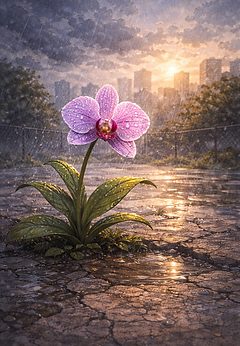
In this garden, flowers grow through cracks in the concrete. They grow in cities, neighborhoods, small towns, countryside fields, and everywhere people live their lives.
The flowers represent us.
Different colors.
Different shapes.
Different paths of growth.
Yet every flower grows under the same sun.
The Concrete Garden reminds us that even in a world that often feels rushed, loud, and divided, something gentle can still grow.
What Makes These Stories Different
Concrete Garden stories are written using a storytelling approach called Poetic Cinema.
Instead of filling every page with pictures, the stories invite readers to imagine the garden themselves.
As the story unfolds, the reader creates the scenes inside their own mind:
The sunlight touching the soil.
The wind moving the petals.
The quiet voices of the flowers learning from one another.
Each story becomes a small movie playing inside the imagination.
This kind of storytelling allows the mind to slow down and explore thoughts and feelings in a calm and reflective way.
A Garden for All Kinds of Minds
The Concrete Garden was created for people from many walks of life.
For children who are learning to imagine and understand their emotions.
For adults who sometimes need a quiet moment away from the noise of modern life.
For seniors who appreciate gentle storytelling and reflection.
For readers who simply enjoy thoughtful stories that move slowly and peacefully.
Many readers today feel surrounded by fast technology, constant screens, and information moving at high speed. Concrete Garden stories offer something different — a return to classic storytelling that allows the imagination to breathe.
They can be especially comforting for readers who enjoy slow, reflective reading and stories that invite personal interpretation.
Each reader may see something different in the garden.
And that is exactly how the garden is meant to work.
For Families, Teachers, and Caregivers
Concrete Garden stories can also be shared in homes, classrooms, and community spaces.
Parents may read them with their children.
Teachers may use them as conversation starters about kindness, curiosity, and understanding.
Caregivers and seniors may enjoy the peaceful rhythm of the stories together.
The garden becomes a place where people can pause, talk, imagine, and reflect.
The Meaning of Concrete Flowers
The idea of Concrete Flowers comes from a simple observation:
Flowers grow everywhere.
They grow in cities.
They grow in villages.
They grow beside highways, buildings, farms, and forests.
They do not care about borders, politics, race, or conflict.
They simply grow where life allows them to grow.
Concrete Flowers reminds us that people are not so different.
Each of us grows from our own experiences and environments, yet we all share the same earth and the same sun.
A Universal Garden
Whether you come from:
a busy city
a quiet rural town
a suburban neighborhood
or somewhere in between
the garden welcomes you.
Because every reader brings their own imagination into the story.
And every imagination helps the garden grow.
A Message from the Creator
The Concrete Garden was created as a way to turn life experiences into something thoughtful and peaceful.
The world can sometimes feel like a concrete jungle.
But even in the hardest places, flowers still grow.
These stories are an invitation to slow down, imagine, and rediscover the beauty of growth — both in the world and inside ourselves.
The garden belongs to everyone.
— Vernon Snell
Creator of Poetic Cinema


How to Experience a Concrete Garden Story
Concrete Garden stories are written using a storytelling approach called Poetic Cinema.
This means the stories are designed to feel like a quiet movie playing inside your imagination.
Unlike many modern books that rely on constant images and fast movement, Concrete Garden invites readers to slow down and imagine the world of the garden themselves.
As you read, allow the story to unfold gently.
Imagine the garden around you.
Imagine the sunlight warming the soil.
Imagine the wind moving through the flowers.
Imagine the voices of the flowers as they learn from one another.
Every reader will see the garden differently.
That is part of the experience.
The stories are meant to be read slowly.
Some readers enjoy reading one story at a time and taking a moment afterward to reflect on what the flower learned.
Others enjoy sharing the stories with family members, students, or friends and discussing what the garden may be teaching.
There is no single correct way to experience the Concrete Garden.
The garden grows differently in every mind.
A Different Kind of Reading
In a world filled with constant screens, fast entertainment, and rapid information, Concrete Garden stories offer something quieter.
They encourage imagination, reflection, and curiosity.
Readers are not simply watching a story.
They are participating in it.
The imagination becomes part of the storytelling.
This type of reading can feel calm, thoughtful, and deeply personal.
Each story becomes a moment where the reader and the garden meet.
The Concrete Garden Library
The Concrete Garden is not just one book.
It is a growing collection of stories that explore the symbolic world of Concrete Flowers.
Each book introduces new flowers, new lessons, and new moments of growth inside the garden.
Just like a real garden, the stories continue to expand over time.
Some stories explore kindness.
Some explore courage.
Some explore patience, curiosity, friendship, and understanding.
Together, they form a growing universe of reflective storytelling.
The World of Concrete Flowers
Concrete Flowers represent people living and growing in all types of environments.
Flowers grow everywhere.
They grow in cities.
They grow in villages.
They grow in rural fields and suburban neighborhoods.
They grow beside sidewalks and buildings.
They do not recognize borders or divisions.
They simply grow wherever life allows them to grow.
Concrete Flowers reminds us that people, like flowers, grow in many different environments but share the same earth and the same sun.
A Growing Collection
The Concrete Garden books are part of the larger Poetic Cinema storytelling universe created by Vernon Snell.
This collection continues to grow with new stories and new reflections about life.
Each book becomes another part of the garden.
Each reader becomes another visitor in the garden.
And each story plants another seed of imagination.
The Garden Is Always Growing
As long as people continue to imagine, reflect, and share stories with one another, the garden will continue to grow.
Concrete Flowers are everywhere.
You only have to look closely to see them.
ks well on almost every site.

The Philosophy of Concrete Flowers
Concrete Flowers is built on a simple but powerful observation.
Flowers grow everywhere.
They grow in cities.
They grow in villages.
They grow in fields and forests.
They grow beside sidewalks, highways, buildings, and homes.
Flowers do not recognize race.
Flowers do not start wars.
Flowers do not divide themselves by language, nationality, or belief.
They simply grow where life allows them to grow.
Each flower is different.
Some grow tall.
Some grow small.
Some bloom quickly.
Some bloom slowly.
But every flower grows under the same sun.
A Symbol of Human Life
Concrete Flowers uses the garden as a symbol for the human world.
People grow in many different environments.
Some grow in busy cities.
Some grow in quiet rural towns.
Some grow in neighborhoods filled with opportunity.
Some grow in places where life is more difficult.
Yet no matter where we grow, we all share the same earth.
The garden reminds us that growth takes many forms.
Some people bloom early in life.
Some bloom later.
Some struggle through difficult seasons before they bloom at all.
But every life carries the potential to grow.
The Concrete Jungle
Many people today describe modern life as a concrete jungle.
Cities move fast.
Technology moves even faster.
Screens, noise, and constant information fill our daily lives.
In this environment it can be easy to forget the quiet rhythms that help people grow — imagination, reflection, patience, and understanding.
Concrete Flowers is a reminder that even in a concrete world, something natural and beautiful can still grow.
The garden is still alive.
A Return to Imagination
The Concrete Garden stories invite readers to slow down and imagine again.
Instead of overwhelming the senses with images and noise, the stories create space for the mind to explore.
Readers create the garden inside their imagination.
They see the flowers.
They hear the wind.
They feel the sunlight.
The story becomes a quiet cinematic experience inside the mind.
This type of storytelling reconnects readers with a simple but powerful human ability:
the ability to imagine.
A Garden for Everyone
Concrete Flowers is meant to be universal.
It speaks to children discovering the world for the first time.
It speaks to adults reflecting on their journey through life.
It speaks to elders who understand the deeper rhythms of growth and time.
It speaks to people living in cities, suburbs, and rural communities alike.
Because the garden belongs to everyone.
The Message of the Garden
The message of Concrete Flowers is not complicated.
Growth is possible everywhere.
Kindness can appear in unexpected places.
Understanding can grow between people who seem very different.
And just like flowers, human beings are capable of blooming even after difficult seasons.
A Living Garden
The Concrete Garden is a growing world of stories.
Each book adds new flowers, new lessons, and new moments of reflection.
The garden will continue to grow as long as readers continue to imagine.
Because in the end, the most important truth of the garden is simple:
Flowers grow everywhere.
And so can we.

The Poetic Cinema Universe
Three Doors Into One Story
The works inside this archive may appear different at first.
Some read like mythology.
Some feel like poetry.
Others feel like real-life testimony.
But they all come from the same place.
They come from one mind observing one ecosystem over time.
The ecosystem is the neighborhood of Washington Heights, where life, survival, joy, danger, culture, and memory all grew together like plants in a crowded garden.
To understand the work, imagine entering the story through three different doors.
Door One: Concrete Flowers
The Symbolic Ecosystem
In the Concrete Flowers stories, the city becomes a garden.
People, institutions, temptations, and cultures appear as flowers growing through concrete.
Each flower represents something inside the ecosystem:
-
survival
-
addiction
-
ambition
-
love
-
struggle
-
community
-
power
The garden shows how environments shape the lives that grow inside them.
It is a symbolic way of understanding the world.
Door Two: The Black Knight Flower
The Witness
Among all the flowers in the garden, one becomes something different.
The Black Knight Flower.
He is not a hero who saves the world.
He is the flower that remembers the garden.
He observes the storms, the music, the laughter, the pain, and the changes that move through the environment.
Sometimes he appears as a flower rooted in the soil of memory.
Sometimes he walks as a human being through the streets.
The Black Knight Flower represents the witness of the ecosystem—the one who sees, survives, and remembers.
Door Three: Poetic Cinema Testimony
The Real Stories
The Poetic Cinema testimony is where the symbolic world meets real life.
These stories come directly from lived experience.
They document:
-
life in Washington Heights
-
the War on Drugs era
-
the cultural crossroads of the neighborhood
-
survival in difficult environments
-
the human emotions behind historical moments
Poetic Cinema tells these stories in a way that allows readers to see the scenes in their minds like a film.
One Garden, One Witness
Concrete Flowers.
Black Knight Flower.
Poetic Cinema.
Three different doors.
But they all lead to the same place.
They lead back to one garden.
And inside that garden, one flower spent his life watching, remembering, and trying to understand what grew there.
The stories you are about to read are part of that memory.
AUTHENTICITY & PROTECTION
The Seal of This Work
This work is offered freely.
Not because it has no value—
but because its purpose is to reach.
Every word, every structure, every layer within this work
comes from lived experience, reflection, and time.
This is not generated for content.
This is created as testimony.
Where this work appears in its original form,
it carries the mark of its creator.
Its structure, its voice, and its method—
are part of a larger body of work known as Poetic Cinema.
This is not just a book.
It is part of a living archive.
Unauthorized copying, reproduction, or misuse of this work
is a violation of that creation.
Respect the work.
Respect the process.
Respect the truth it carries.
ACCESS THE BOOK
This work is available to you freely.
To begin your experience,
press the cover.
Enter slowly.
Take your time.
This is not a race.
SUPPORT THE WORK
For Those Who See the Value
If this work reaches you…
If it helps you understand something more clearly…
If it gives language to something you have felt…
You are invited to support its continuation.
This work is built independently—
without institutions, without backing,
driven only by purpose and lived experience.
Your support helps expand this vision into:
• More Poetic Cinema works
• Educational tools for younger generations
• Visual and cinematic adaptations
• A growing archive designed to reach people worldwide
This is not just about one book.
It is about building something that lasts.
If you choose to support—
you are not just giving.
You are helping this work move further.
FINAL NOTE
This is free to access.
But its value is not measured by price.
It is measured by what it gives you…
and what you choose to do with it.

If you would like to hear the creator explain the origins of Concrete Flowers, press the button below.
In this short presentation, Vernon Snell — founder of Poetic Cinema — explains the deeper meaning behind the Concrete Flowers concept, how it was born from lived experience, and why these stories were created as a living archive.
Due to the size of the original video file, this presentation is hosted externally.
Press the button to watch the full explanation.
Watch the Creator’s Explanation


-
Discover More Works
-

THANK YOU

